Oilfield services in Venezuela
Fluid Transport
Suction where conventional pumps cannot reach.
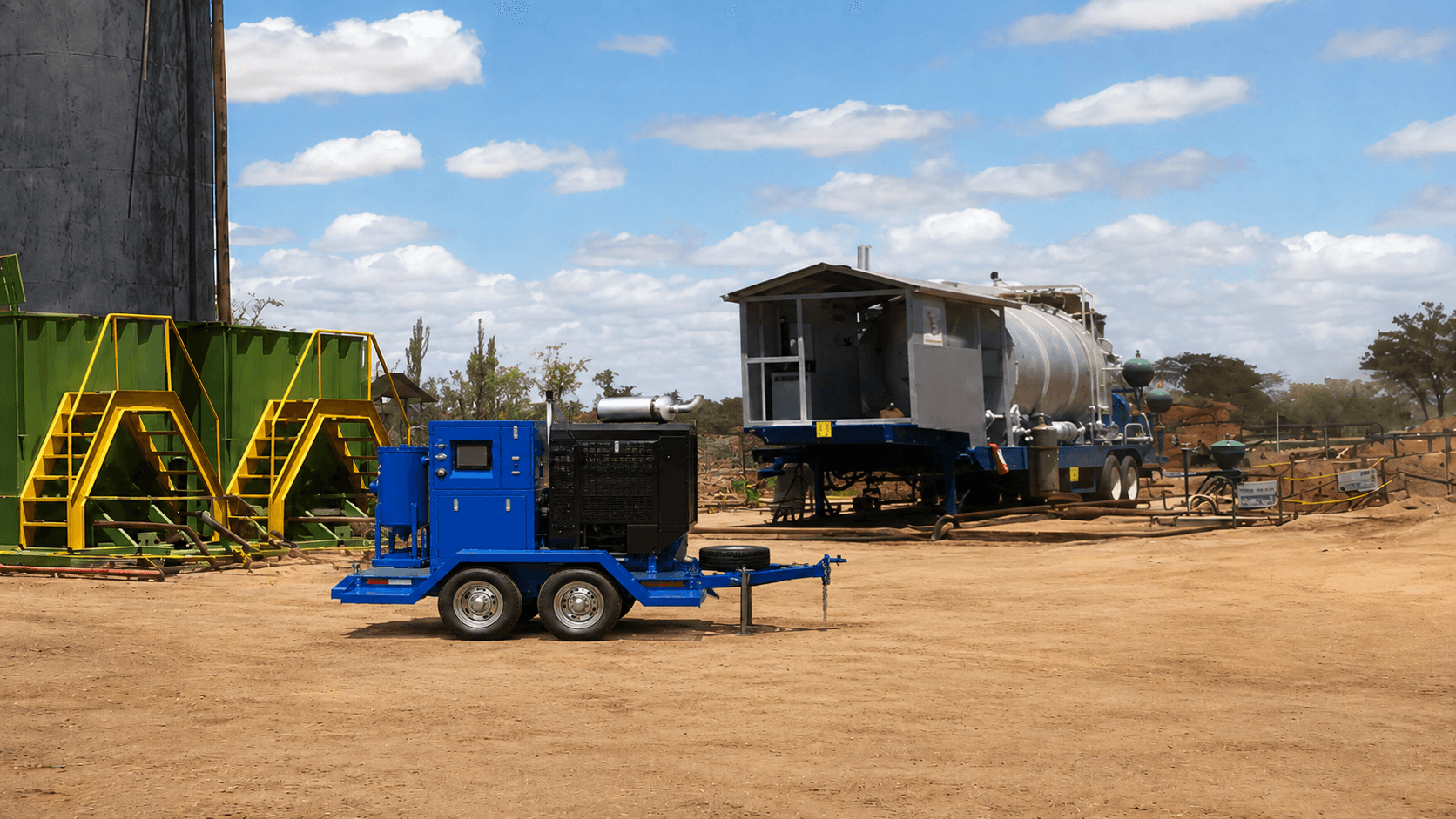
160-barrel semitrailer with an NVE Challenger 607 compressor and Isuzu 4BD1 engine.
From Zulia, for all of Venezuela.

The service
Our own unit, manufactured in 2026
Vacuum transfer provides a solution for high-density, high-viscosity fluids that cannot be moved by conventional means. We have our own 160-barrel vacuum unit, manufactured in 2026 to the standards of the Venezuelan oil industry.
Discuss your operation with our teamHow we work in the field.
Discover the stages and equipment involved in this operation.
 We position the unit
Technical capability
The equipment behind the service.
Review the specifications and scope to plan your operation.
- Our own 2026 equipment
A unit manufactured in 2026 with updated technology, current maintenance and valid certifications.
- Confined-space access
Vacuum technology extracts fluids from pits, tank bottoms and areas with limited mechanical access.
- No direct contact
Operators do not come into contact with the fluid, reducing exposure risks from hazardous or toxic substances.
- Full traceability
We issue waste manifests and volume reports for each operation to support regulatory compliance.
Technical specifications
Soluciones Delta C.A.- Tank capacity
- 160 Bbl (25,440 L)
- Material
- A36 steel · 8 mm
- Compressor
- NVE Challenger 607 PRO
- Free air flow
- 380 CFM
- Maximum vacuum
- 29" Hg
- Maximum pressure
- 30 PSI
- Operating speed
- 1,250 RPM
- Power required
- 25 HP (vacuum) / 28 HP (20 PSI)
- Porting
- 3 inches
- Compressor engine
- Isuzu 4BD1
- Tank dimensions
- 11.60 m × Ø 1.85 m
- Manufactured
- 2026
Equipment availability and service conditions are confirmed when quoting.
Plan your operation
Applications and scope.
Information about the process, fluids, safety and resources supporting this service.
What is vacuum transfer?
Vacuum transfer creates a pressure difference that draws fluid into the unit's tank. Unlike positive-pressure pumping, vacuum works by suction, allowing fluid extraction from confined spaces, pits, tank bottoms and hard-to-reach locations.
Our vacuum unit — Technical specifications
Our vacuum semi-trailer, manufactured in 2026, has the following technical specifications:
- Nominal capacity: 160 barrels (25,440 liters)
- Material: A36 structural steel, 8 mm thick
- Outside diameter: 1.85 meters
- Overall length: 11.60 meters
- Empty weight: 6,000 kg
- Compressor: NVE Challenger 607
- Compressor engine: Isuzu 4BD1
- Connections: 4-inch inlet and outlet
- Valves: butterfly type, calibrated and certified
- Gauge: calibrated pressure and vacuum gauge
- Axles: 2 axles with American-type hubs
- Grounding system: Copperweld rod, 1/0 gauge, 3 meters
NVE Challenger 607 PRO compressor — Technical specifications
Our vacuum units use the NVE Challenger 607 PRO Heavy-Duty compressor, made in the USA and recognized as an industry standard for oilfield vacuum operations:
- Free air flow: 380 CFM
- Maximum vacuum: 29 inches Hg (full vacuum)
- Maximum pressure: 30 PSI
- Nominal operating speed: 1,250 RPM
- Power required under vacuum: 25 HP / at 20 PSI: 28 HP
- Porting: 3 inches
- Ductile iron housing with a lifetime warranty against cracking
- NVE-exclusive bidirectional oil management with 4 ports: adjustable from 5–24 oz/hour
- Integrated vacuum/pressure changeover valve
- Accessible, cleanable stainless steel final filter
- Exhaust temperature monitoring thermometer
- Drive options: gearbox, belt, hydraulic and direct
- 2-year manufacturing defect warranty · Designed and manufactured in the USA
Which fluids is it designed for?
The vacuum unit is specifically designed for challenging industrial fluids:
- Asphaltic sludge: semi-solid residue from tank bottoms and pipelines
- Drilling and completion muds (water-based and oil-based)
- Produced water with high concentrations of solids and sediment
- Spilled heavy and extra-heavy crude, or oil in pits
- Fluids containing suspended solids (cuttings, formation sand)
- Industrial effluents containing heavy metals or high salinity
- Storage tank cleaning residues
- Contaminated rainwater at oilfield locations
Other names for this service
In the industry, this service is also known as:
- Vacuum truck services for oil & gas
- Drilling fluid suction and transport
- Crude oil storage tank cleaning
- High Vacuum Units (HVU) for the oil industry
- Industrial effluent and hazardous waste management
- Sludge extraction using a vacuum tanker truck
- Heavy and extra-heavy crude transfer
Operating process
Our vacuum operations follow a controlled, documented procedure:
- 1. Site inspection and assessment of the fluid to be extracted
- 2. Strategic positioning of the vacuum unit
- 3. Grounding system installation (required for volatile fluids)
- 4. Suction hose connection using certified 4-inch couplings
- 5. Starting the NVE compressor and drawing a vacuum in the tank
- 6. Controlled suction with level and pressure monitoring
- 7. Transport to the disposal or treatment site
- 8. Discharge and equipment cleaning
- 9. Waste manifest issuance, where applicable
How does vacuum transfer differ from conventional pumping?
Conventional pumping pushes fluid using positive pressure, while vacuum draws it in using negative pressure. Vacuum is particularly suitable for extracting fluids from enclosed spaces, tank bottoms and pits, as well as semi-solid materials that cannot flow on their own.
Can you handle fluids containing volatile gases or H2S?
Yes. The unit has a certified grounding system (1/0 gauge Copperweld rod) and sealed valves for handling fluids containing H2S or volatile gases. Personnel use certified respiratory protection equipment.
How long does it take to fill the vacuum tank?
Filling time depends on fluid viscosity and suction distance. For water-based fluids or light muds, filling the 160 Bbl tank takes approximately 45–90 minutes. Asphaltic sludge or highly viscous materials may take 2–4 hours.
Where is the extracted material taken?
The destination depends on the material: reusable fluids go to storage tanks, produced water to authorized injection wells, and hazardous waste to certified final disposal companies. We issue waste manifests for traceability.


Let's talk about your project
Your next operation starts here.
Tell us where and when you need the service. Our team will help define the equipment and scope.
+58 424-6472446Support from San Francisco, Zulia.