Oilfield services in Venezuela
Industrial Hydrojet Cleaning
Water that cuts metal. No sparks, no abrasives.
Heat exchangers, line clearing, surface preparation and confined spaces.
From Zulia, for all of Venezuela.
The service
Cold work for hazardous areas
Industrial hydrojet cleaning uses pressurized water to remove deposits and prepare surfaces. At Soluciones Delta, we assess equipment materials, deposit types and access to define the unit and accessories. The service can integrate vacuum fluid collection and waste management, according to the contracted scope.
Discuss your operation with our teamHow we work in the field.
Discover the stages and equipment involved in this operation.
 We select the unit
Technical capability
The equipment behind the service.
Review the specifications and scope to plan your operation.
- Cold work, without sparks
Water cutting does not generate sparks or heat and is the required standard for refineries, classified areas and active drilling locations.
- Sustained 40,000 PSI
UHP pumping units driven by heavy-duty diesel engines can maintain maximum pressure throughout the workday.
- No abrasives or chemicals
Pure-water cleaning does not damage the metal substrate or generate secondary abrasive waste, reducing the environmental impact of each operation.
- HSE-certified crew
An HSE supervisor, operators trained in body mechanics and an equipment specialist at each location, with certified UHP protective PPE.
Technical specifications
Soluciones Delta C.A.- Maximum UHP pressure
- 40,000 PSI (2,800 bar)
- Maximum HP pressure
- 20,000 PSI (1,400 bar)
- UHP flow rate
- 3.0 – 6.0 GPM
- HP flow rate
- 10.0 – 13.0 GPM
- UHP engine
- John Deere 6068H · 250 HP
- HP engine
- John Deere 4039D · 70 HP
- UHP pump
- Triplex Plunger
- UHP hose
- 60,000 PSI burst pressure
- Nozzles
- Sapphire / industrial diamond
- Filtration
- Dual: 10 + 5 microns
- Mounting
- Towable skid
- Availability
- 24 hours / 7 days
Equipment availability and service conditions are confirmed when quoting.
Plan your operation
Applications and scope.
Information about the process, fluids, safety and resources supporting this service.
Pipeline, tank and heat exchanger cleaning
Work is organized around restoring the equipment to service. We review these applications with the client:
- Process pipelines: internal cleaning and deposit removal based on diameter and access
- Heat exchangers: tube bundle cleaning during maintenance
- Tanks: deposit removal and coordination of fluid collection
- Industrial surfaces: preparation and coating removal suited to the material
Integrated service scope
We cover ultra-high-pressure water cleaning applications in oilfield and industrial facilities:
- Heat exchanger maintenance: deep cleaning of tube bundles, condensers and boilers to restore plant thermal efficiency
- Line clearing and flow restoration: removal of coke, asphaltenes, polymers, resins and hardened sediment in process pipelines
- Surface preparation (cold work): removal of paint, rust and metal scale using water cutting without sparks, as required in refineries and active drilling locations
- Confined-space cleaning: bottom sludge removal in crude storage tanks
- Integrated operation: work with our 160-barrel vacuum units for immediate residue suction and compliance with RACDA regulations
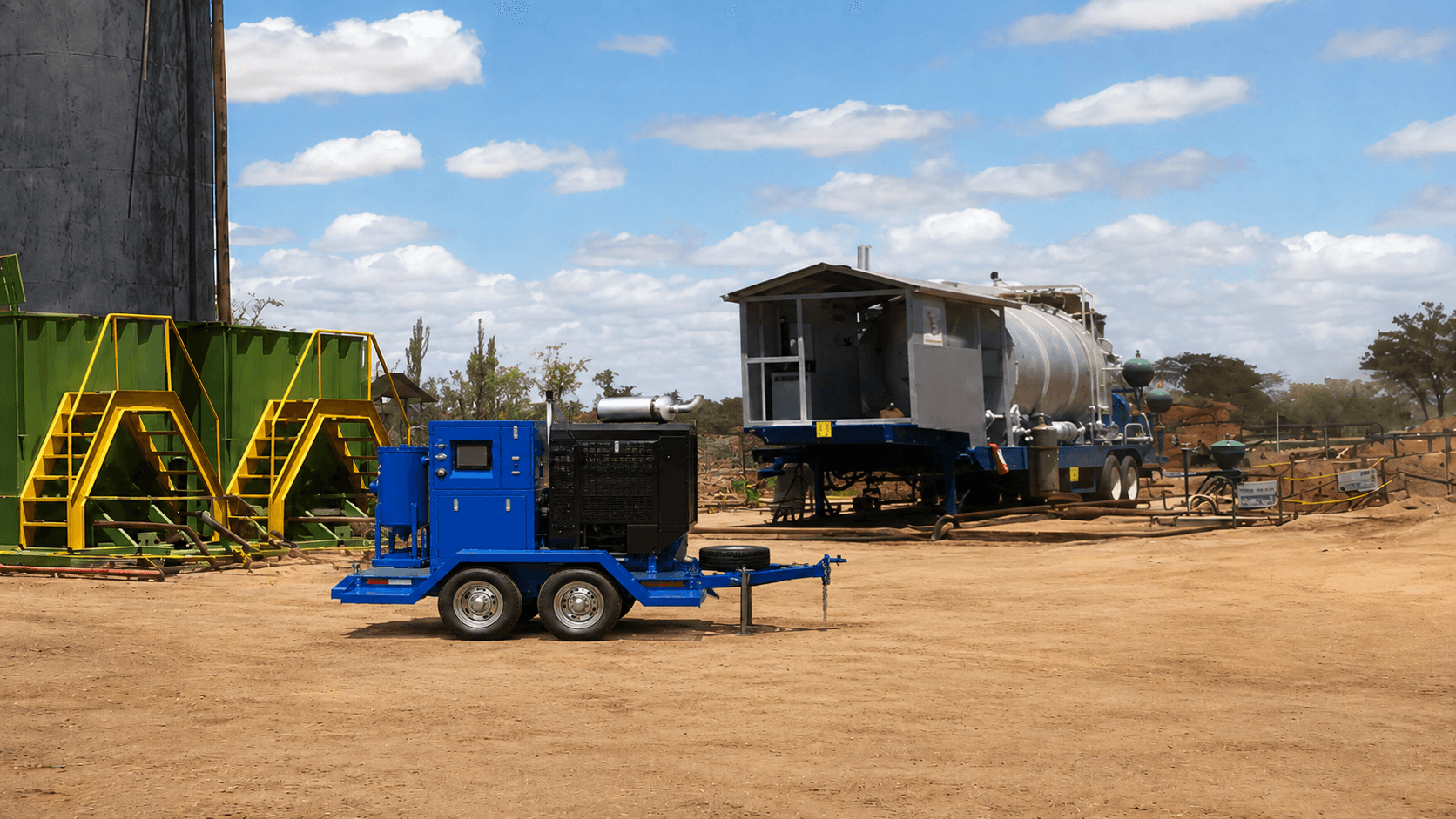
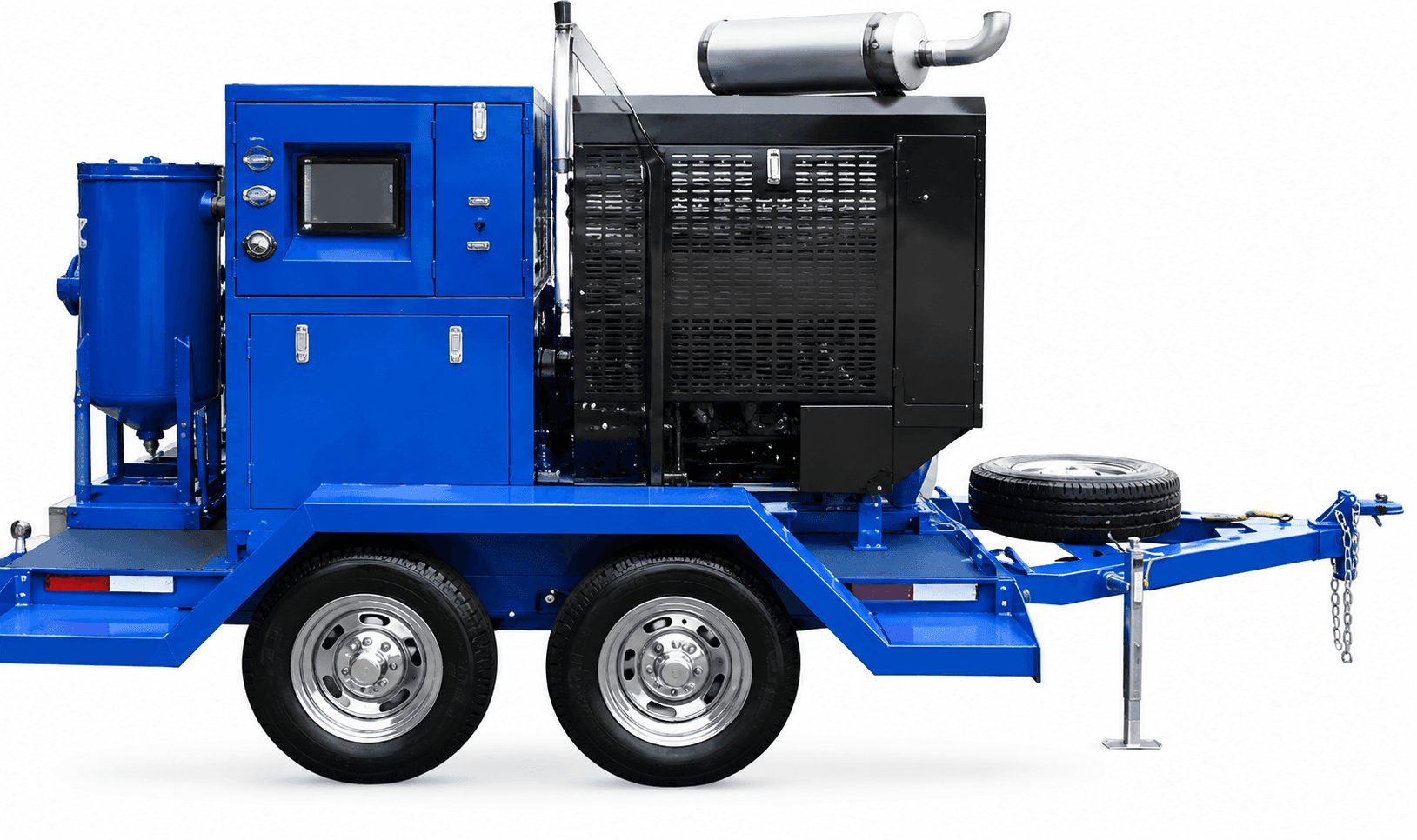
40,000 PSI UHP unit — Technical specifications
Industrial equipment designed for concrete hydrodemolition, heavy epoxy coating removal and abrasive-free stripping (pure water blasting):
- John Deere 6068H diesel engine: 6 inline cylinders, turbocharged and aftercooled, 6.8 L
- Rated power: approximately 250 HP at 2,200 RPM with high-pressure common rail (HPCR) injection
- Ultra-high-pressure (UHP) triplex plunger pump
- Maximum working pressure: 40,000 PSI (2,800 bar)
- Average flow: 3.0–6.0 GPM (11.4–22.7 LPM)
- Transmission: Twin Disc SP211HP5 heavy-duty clutch, SAE 5 coupling
- Solid fluid end machined from special stainless steel or titanium alloys
- Safety: rupture disc valve and pneumatic regulating bypass valve
- Reinforced carbon steel skid frame on H-beams
20,000 PSI PARTEK HP unit — Technical specifications
High-pressure equipment for industrial washing, severe rust removal and internal heat exchanger and pipeline cleaning, combining high water volume with impact force:
- John Deere 4039D diesel engine: 4 inline cylinders, naturally aspirated, 3.9 L
- Rated power: approximately 70 HP at 2,150 RPM with mechanical direct injection
- PARTEK high-pressure pump
- Maximum working pressure: 20,000 PSI (1,400 bar)
- Average flow: 10.0–13.0 GPM (38–50 LPM)
- Aircraft-grade stainless steel fluid end with water-cooled ceramic plungers
- Safety: adjustable mechanical relief valve and automatic low-oil-pressure shutdown
- Skid frame with an integrated fuel tank for extended operation
Accessories and working technology
The 20,000 and 40,000 PSI working kit includes certified components for safe, efficient operation:
- Multilayer thermoplastic hoses (4–6 layers of spiral steel) rated for 40,000 PSI operation and up to 60,000 PSI burst pressure
- High-safety stainless steel autoclave cone-and-thread connections
- Safety cables (whipchecks) to prevent hose whipping if a coupling fails
- Pneumatic dump gun: releasing the trigger diverts water to zero pressure
- Foot control valve for hands-free internal pipe cleaning
- Self-rotating nozzles with sapphire or industrial diamond inserts
- Self-propelled nozzles for internal pipe cleaning
- Mechanical positioners and crawlers that keep operators away from direct exposure
- Critical two-stage pump feed filtration: 10 microns + 5 microns
Operations crew and field leadership
Every operation has a defined command structure and certified personnel:
- Crew leader (HSE supervisor): assesses risks, arranges work permits, marks the exclusion zone and coordinates logistics with the vacuum unit
- Certified operators: technicians trained in body mechanics to manage lance recoil
- Equipment specialist: calibrates relief valves, purges lines and ensures continuous pump operation each shift
- Mandatory protective PPE: full UHP Kevlar/Dyneema (UHMWPE) suit certified against direct jet impact
- Boots with steel or titanium metatarsal protection and protective gloves
- Helmet with a full-impact face shield against high-speed particles
Operational safety procedure
At 40,000 PSI, a water jet cuts metal. Every job follows a strict, documented procedure:
- 1. Job risk assessment (ART) and on-site permits
- 2. Exclusion zone marking and signage
- 3. Hose, whipcheck and rupture disc inspection
- 4. Progressive system pressure test before operation
- 5. Operation with a permanent on-site HSE supervisor
- 6. Immediate residue suction using a 160 Bbl vacuum unit
- 7. Safe disconnection, depressurization and work permit closure
What information is needed for a hydrojet cleaning quote?
Share the location, the equipment or surface to be cleaned, dimensions, material and deposit type. Include photos if available, work dates, access conditions and water availability. Specify whether you also need vacuum collection and waste management.
Is hydrojet service available outside Zulia?
We accept requests for oilfield and industrial facilities throughout Venezuela. Our team reviews the location, scope and unit availability before confirming mobilization from Zulia and the terms of the quote.
When is the 20,000 PSI unit used instead of the 40,000 PSI unit?
The 20,000 PSI PARTEK unit has a higher flow rate (10–13 GPM), suitable for industrial washing, severe rust removal and internal heat exchanger and pipeline cleaning, where water volume and impact force do the work. The 40,000 PSI UHP unit concentrates energy into a lower flow (3–6 GPM) for concrete hydrodemolition, heavy epoxy coating removal and abrasive-free stripping requiring cutting power.
Why is hydroblasting safer than sandblasting in refineries?
It is a cold-work process: water cutting generates no sparks or ignition sources, allowing operation in classified areas containing hydrocarbons. It also avoids silica dust clouds and contaminated abrasive waste, and does not wear down the cleaned equipment's base metal.
What safety measures protect personnel?
The operator wears a full UHP protective suit made from Kevlar/Dyneema fibers certified against direct jet impact, boots with steel or titanium metatarsal protection, a full-impact face shield and protective gloves. Pneumatic dump guns reduce water pressure to zero when the trigger is released; each coupling has a whipcheck and the system uses calibrated rupture discs. An HSE supervisor leads every operation with work permits and a marked exclusion zone.
What happens to the waste generated by cleaning?
We work with our 160-barrel vacuum units to immediately collect sludge, water and residues generated during washing, keeping work areas clean and complying with RACDA regulations. Hazardous residues are handled through our waste management service under Decree 2635.
Can you clean pipes internally without dismantling them?
Yes. We use self-propelled nozzles with angled rear jets that pull the flexible hose into the pipe, and multilayer hoses selected for pipe diameter and deposit type. For heat exchanger tube bundles, we use rigid lances and semi-automated positioners to keep operators away from direct exposure.


Let's talk about your project
Your next operation starts here.
Tell us where and when you need the service. Our team will help define the equipment and scope.
+58 424-6472446Support from San Francisco, Zulia.